


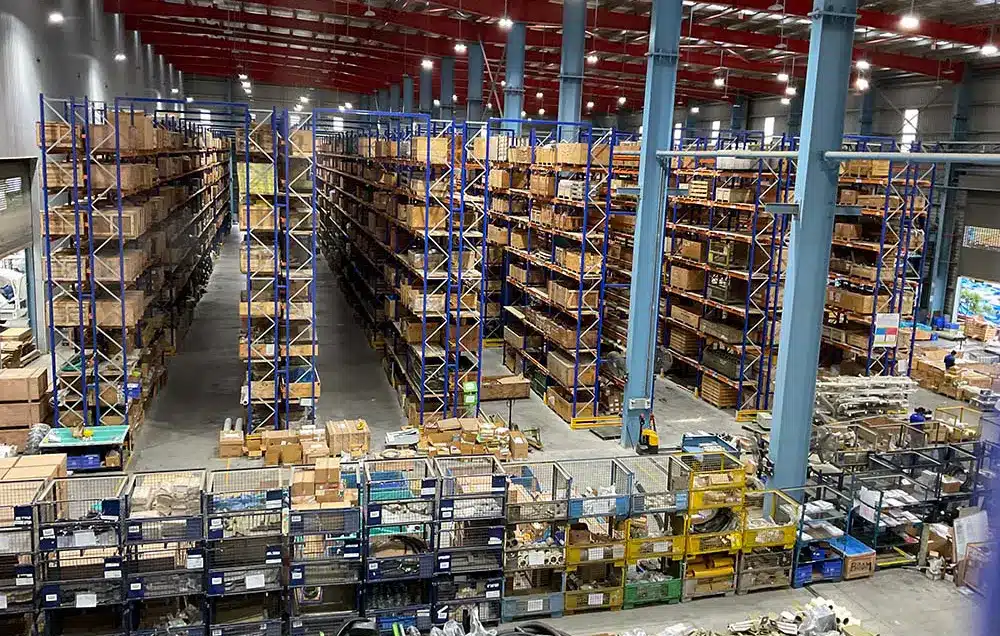
Ask any warehouse manager what keeps them up at night and three things usually come up immediately; running out of room, goods that move too slowly, and stock that gets damaged in the shuffle. Racking sits right at the centre of all three. Get it wrong and it shows up in the numbers within months, not years. This piece looks at what actually makes a pallet rack manufacturer worth trusting, which heavy duty setups genuinely handle bulk storage well, and the groundwork that’s worth doing before any supplier gets a purchase order.
Top Pallet Rack Manufacturers for Warehouse Storage
Identify a trustworthy pallet rack manufacturer that combines the most common qualities such as engineering quality, strength of the racks, along with post-sales support, timely delivery, and compatibility with important safety standards. However, that is not the complete story. In India, the industrial racking sector has grown steadily alongside e commerce, automotive, pharmaceutical, and FMCG warehousing, and a handful of manufacturers, Metal Storage Systems Pvt. Ltd. (METSTO) among them, have built solid reputations through consistent quality and wide service coverage.
METSTO has been around for close to two decades now and holds ISO 9001:2015 certification. Its manufacturing base spans over 2,50,000 square feet and is built around European shearing and forming machinery, with several rack sections formed from continuous coil so there are fewer weld joints, which makes for sturdier uprights and beams. Service coverage stretches across more than 17 cities, including Bengaluru, Chennai, Hyderabad, Pune, Coimbatore, Delhi, and Ahmedabad, and the company works with clients in automotive, tyre, pharmaceutical, food and beverage, aviation, and electronics.
Strip away the brand names, though, and a pattern still shows up among the manufacturers worth trusting. Ownership of the fabrication process is one marker. Companies forming their own steel usually have more control over consistency than those reselling under their own label. Paperwork is another tell. A manufacturer that can hand over the structural calculations behind a load rating has done the engineering, not just guessed at it. Coverage matters as well, because a brilliant rack from a company with no presence anywhere near your facility becomes a headache the day something needs servicing. And breadth of client history, spanning industries as different as pharma and heavy equipment, tends to line up with a manufacturer being able to handle whatever odd request your warehouse throws at them.
None of that shows up on a spec sheet, really. It shows up in whether the company bothers to ask what you’re storing, whether someone walks your floor before quoting, and whether what comes back is a layout built for your business rather than a page lifted from a brochure.
What Type of Heavy Duty Pallet Racking System Suits Bulk Storage?
Bulk storage usually means large quantities of similar or identical products, high pallet turnover, and a need to squeeze the most out of both floor space and vertical height. Not every racking type is built for that, and manufacturers like Metal Storage Systems Pvt. Ltd. (METSTO) design specific configurations to handle it. Here’s what tends to work best.
Drive in and drive through configurations come first. Forklifts drive right inside the rack itself here, letting pallets stack several deep in one lane instead of just one to a bay. Cold storage and FMCG businesses lean on this whenever a single SKU shows up in large batches. Drive in racking pulls the newest pallet out first. Drive through, open at both ends, moves stock in the order it arrived instead.
Mobile racking tackles the same density problem a different way. Entire rows sit on trolleys that glide along floor rails, so only one aisle needs to stay open instead of several standing empty just in case. That one change can lift capacity on the same floor area by roughly 60 to 80 percent, which is worth taking seriously if it’s square footage, not money, that’s actually running out.
Most operations, though, still end up leaning on heavy duty selective racking as their default. It keeps every pallet within arm’s reach, grows easily as inventory expands, and doesn’t stretch the budget or the installation schedule too far. If a building has spare vertical room, multi tier or mezzanine style shelving piles extra levels on top of the existing floor space, a good match for lighter or boxed goods stored in bulk.
The final call really comes down to a few practical things: how much weight each pallet carries, how quickly it needs to move, what forklift equipment is already on the floor, and whether stock has to come out one pallet at a time or can sit undisturbed several rows deep.
What Should I Check Before Selecting Industrial Rack Manufacturers?
A handful of things separate a solid industrial rack manufacturer from a risky one: build quality, load capacity documentation, how they assess your site, how far they’re willing to customise, after installation support, and certifications. This really isn’t a purchase to rush. Racking stays bolted to a floor for a decade or more, and a company like Metal Storage Systems Pvt. Ltd. (MESTO) gets judged on exactly these fronts by buyers weighing it up. Here’s what’s worth running through before you lock in a supplier.
Build quality
- Check the steel grade and corrosion protection used
- Ask whether parts came off the manufacturer’s own line or were assembled elsewhere by a third party
Load capacity documentation
- Look for a documented safe load figure for each bay and level
- Be wary of a rounded estimate pulled off a generic price list
Site assessment
- A good supplier insists on seeing the warehouse before finalising anything
- Ceiling clearance, floor strength, and forklift movement should all get checked in person
- Skipping this step usually means fixes arrive later, at a worse price
Customisation
- Ask directly whether beam length and bay width can flex to match your building
- A rigid, one-size-fits-all setup is a warning sign
After installation support
- Confirm crews are actually available in your region
- Ask what ongoing maintenance looks like in practice
Certifications and references
- ISO certification and safety code compliance should be independently verifiable
- Request references from your own industry rather than relying on a brochure
All this legwork upfront is far cheaper than finding out about the gaps once the racks are already bolted to the floor.
FAQs
Q1. How long does a heavy duty pallet racking system typically last?
If it’s installed correctly, kept within its rated load, and inspected on schedule, a well built heavy duty racking system usually runs for 15 to 20 years. Actual lifespan still shifts depending on how hard the warehouse pushes it day to day.
Q2. Can pallet racking systems be customised for irregular warehouse layouts?
Generally, yes. Manufacturers with real engineering capability can adjust bay width, beam length, and frame height around awkward columns, low ceilings, or an odd floor plan. That’s exactly why a site visit before manufacturing tends to pay off in the end.
Q3. What is the difference between selective and drive in pallet racking?
Selective racking keeps every pallet reachable at any moment, which suits a wide product mix well. Drive in racking gives up some of that reach in exchange for packingfar more stock into the same space, a better trade when fewer SKUs move in much larger volumes.
