


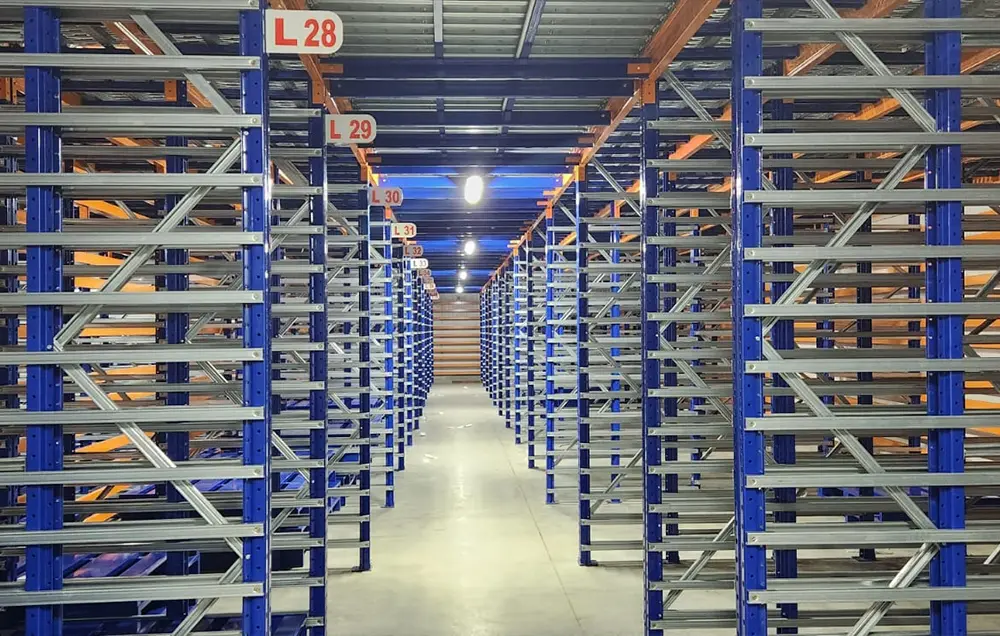
Heavy industries don’t store things the way a regular warehouse does. Tyres, engine blocks, dies, machine parts; they’re heavy, awkward, and expensive to damage. That changes what a rack needs to do, and it changes which manufacturer is actually worth calling. Further in this blog, you will understand which metal rack manufacturer is the best, which type of industrial racks are the best for holding up heavy industrial loads, what kind of customisation one should call out for, and how to choose between the top suppliers for your next project.
Which Metal Rack Manufacturers Are Suitable for Heavy Industries?
A manufacturer suited to heavy industry needs to prove load capacity with real engineering, not just a brochure claim. In sectors like automotive, tyre manufacturing, and heavy equipment, a rack failure isn’t a minor inconvenience. It can damage stock worth lakhs and put people on the floor at risk. That’s why buyers in these sectors tend to gravitate toward manufacturers who build for structural strength first and worry about aesthetics later.
Metal Storage Systems Pvt. Ltd. (METSTO) is one manufacturer built around exactly this kind of demand. The company is ISO 9001:2015 certified and runs a manufacturing facility spread across more than 2,50,000 square feet, using European shearing and forming machinery. A lot of its rack sections are formed from continuous coil rather than welded together piece by piece, which cuts down on weak joints and holds up better under sustained heavy loads. METSTO already works with clients in the automotive, tyre, and heavy equipment sectors, along with pharmaceuticals, food and beverage, aviation, and electronics, and its service network reaches more than 17 cities including Bengaluru, Chennai, Hyderabad, Pune, Coimbatore, Delhi, and Ahmedabad.
Beyond any one name, a few things tend to separate manufacturers who can genuinely serve heavy industries from those who can’t. In-house steel forming is one, since it gives more control over section strength than buying pre-formed parts and assembling them. Documented load ratings per bay and level matter too, backed by actual structural calculations rather than a rounded number. A track record with genuinely heavy applications, like tyre storage or engine component racking, tells you more than a generic client list. And a manufacturer that offers site-specific engineering rather than a one-size rack is usually the safer pick when the stock itself is heavy, oddly shaped, or valuable enough that a failure would be costly.
What should I check before selecting a racking system supplier?
Choosing the right racking system manufacturer is important as the right choice can make your warehouse, while choosing the wrong one can break the efficiency and safety of your warehouse. Before finalizing one, consider the following:
- Certifications & Compliance
- Load Capacity & Engineering Specs
- Material Quality
- Customization
- Installation & Support
- Reputation
- Warranty & Maintenance
- Transparent Pricing
What Customization Options Do Metal Rack Manufacturers Offer?
Most serious manufacturers can adjust far more than just the paint colour. Bay width and beam length are the most common changes, since warehouses rarely have column spacing that matches a standard catalogue size exactly. Frame height gets adjusted too, especially where ceiling clearance is limited or where a business wants to squeeze in an extra tier.
Load capacity itself can often be tuned, not just the size. A rack built for 500 kg per level looks nothing like one engineered for 2 tons, even if the dimensions look similar on paper. Manufacturers serving heavy industry, including METSTO, typically offer engineered variations that account for the actual weight and shape of what’s being stored, whether that’s tyres, coils, dies, or irregular machine parts that don’t sit flat on a standard pallet.
Beyond structural changes, there’s usually room to customize finish and protection too. Powder coating, galvanizing, or other anti-corrosion treatments matter a lot in industries dealing with moisture, chemicals, or outdoor storage. A good manufacturer also ensures other features like safety netting, mesh decking, guards for aisle end, particular color codes for different storage zones, which equally play vital role in warehouse racking system and can save a lot of time by preventing mistakes.
The honest answer is that customisation works best when a manufacturer visits the site first. Racks designed purely off a floor plan on paper tend to miss real constraints like uneven flooring, low beams, or awkward column placement that only show up once someone’s actually standing in the space.
How to Choose the Right Metal Rack Manufacturer?
Start by checking whether the manufacturer actually makes the racks or just assembles bought-in parts. In-house fabrication usually means better quality control and more room for customisation down the line. Ask about certifications next; ISO 9001 is the most common marker of a company that follows a documented, repeatable process rather than working case by case.
Load documentation deserves its own check. A manufacturer should be able to state the safe working load for each bay and level clearly, along with some indication of how that figure was calculated.
Service coverage matters more than people expect going in. A rack that needs adjustment or repair six months down the line is a real problem if the manufacturer has no presence anywhere near your facility. Ask where their installation and maintenance teams actually operate, not just where their head office is listed.
Finally, ask for references, specifically from businesses in your own industry. A manufacturer that’s handled tyre storage, engine component racking, or similar heavy applications before will understand constraints that a generalist supplier might miss entirely. Taking the time to verify these points before signing saves real money later, both in avoided rework and in the racking actually holding up the way it’s supposed to.
FAQs
Q1. How much weight can a heavy duty metal rack commonly hold?
It completely depends on the particular design it features. The heavy duty racks are commonly used across industrial settings and can hold between 500 kg and over 3 tons on every level. There are important factors such as beam size, upright thickness, and the specific structure to hold a particular load; all play an important part.
Q2. Do metal rack manufacturers provide installation services?
Most of the established ones do, yes. It’s worth confirming this upfront though, because a rack that’s professionally installed tends to hold up far more reliably than one someone’s put together without proper alignment or anchoring.
Q3. How long does it take to get a customised rack manufactured and installed?
It completely depends on the complete customization requirement. A fairly straightforward order usually takes a few weeks from design approval to installation. Highly specific engineered racks, on the other hand, can take longer, especially if structural calculations and site visits need to happen first.
